
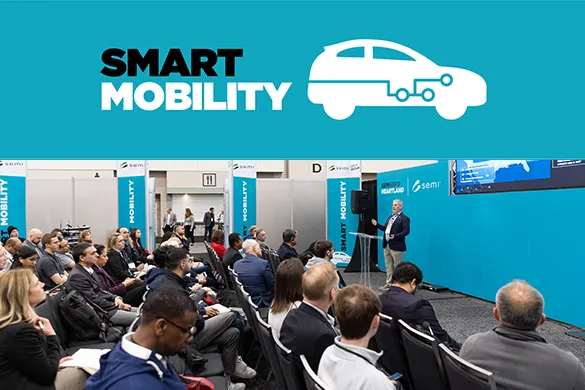
The SEMIEXPO Heartland Mobility sessions are designed to bring the automotive and semiconductor supply chains together with the goal to exchange perspectives on the game-changing trends such as software-defined vehicles, self-driving cars, electrified mobility, and how all that is powered by cutting edge chip technologies, smart sensing systems, and artificial intelligence.
Join us for a lineup of focus sessions that will feature keynotes, expert presentations, panel discussions, and most of all: YOU!
Explore the Sessions
SESSION 1—SEMICONDUCTORS FOR AUTOMATED DRIVING AND ELECTRIC MOBILITY
Automated and electric vehicles are fundamentally enabled by advances in both compute and power semiconductors. This session highlights how semiconductor innovation supports intelligent perception and decision-making for ADAS and autonomous systems, while meeting stringent requirements for performance, efficiency, functional safety, and fail-operational design. In parallel, it explores power semiconductors for electrified powertrains and charging infrastructure, focusing on wide-bandgap technologies such as SiC and GaN, higher voltage architectures, and their impact on efficiency, thermal performance, and fast charging. Attendees will learn how integrated semiconductor advances are driving safe, scalable, and high-performance next-generation mobility.
SESSION 2—TRADE AND PARTNERSHIPS PANEL
The global semiconductor landscape for automotive is increasingly shaped by geopolitical and economic dynamics. This session analyzes tariff impacts and regulatory differences across the U.S., EU, and China, and how they influence sourcing, certification, and product strategies. We discuss the shift toward re-shoring, near-shoring, and vertical integration as OEMs and suppliers seek greater supply-chain resilience. Industry alliances and cross-border R&D partnerships are explored as mechanisms for accelerating innovation, improving data sharing, and mitigating fragmentation in standards. Attendees will understand how strategic collaboration and policy alignment can strengthen competitiveness and ensure reliable access to critical semiconductor technologies.
SESSION 3—SYSTEMS AND ARCHITECTURES FOR THE SOFTWARE-DEFINED VEHICLE
As vehicle electronics grow in complexity, OEMs face critical architectural choices among domain, zonal, and centralized compute models. This session examines how innovative semiconductors—ranging from chiplets to specialized accelerators and advanced nodes—enable scalable, software-defined platforms. We explore edge computing for real-time functions, cloud-based offloading for data-intensive workloads, and the role of virtualization and hypervisors in consolidating ECUs safely. Additionally, digital-twin methodologies are highlighted as tools for continuous validation, lifecycle optimization, and over-the-air development. Attendees will gain insights into how semiconductor technologies and architectural strategies converge to support high-performance, upgradable automotive systems.
SESSION 4—SKILLS & TRAINING FOR AUTOMOTIVE SEMICONDUCTORS PANEL
The convergence of automotive, semiconductor, and software industries is creating new and urgent workforce requirements. This session explores the skills and competencies needed to support next-generation automotive semiconductors, from chip design and power electronics to system integration, functional safety, and hardware–software co-design. Panelists from industry, academia, and policy will discuss talent shortages, upskilling and reskilling strategies, and how education and corporate training programs must evolve. The discussion also addresses interdisciplinary capabilities spanning engineering, regulation, economics, and leadership. Attendees will gain insights into workforce development models and talent strategies essential for sustaining innovation and competitiveness.